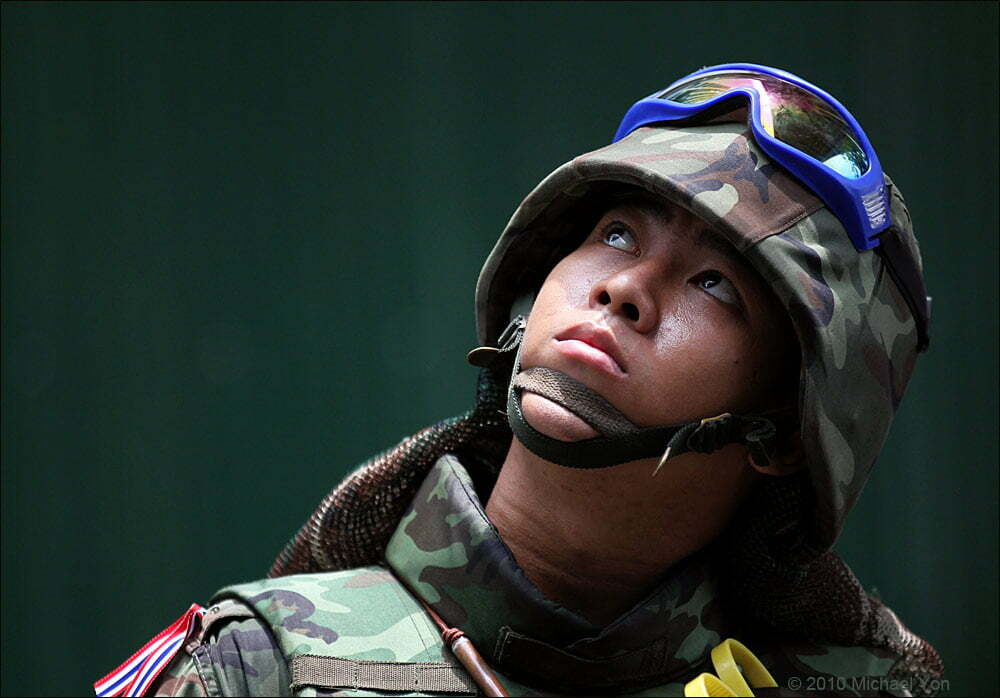

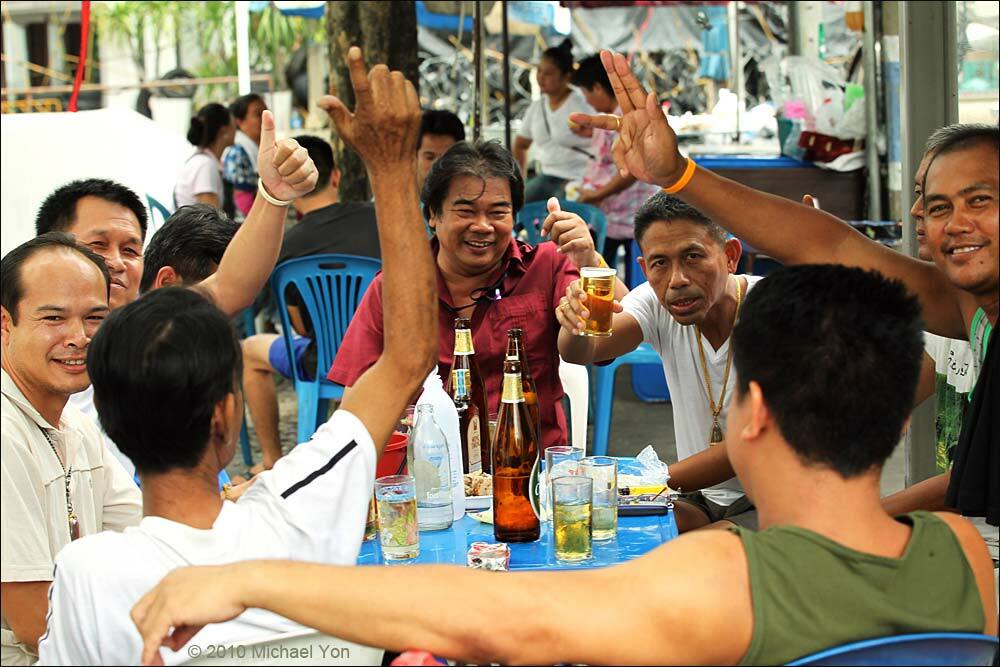
Just outside Red camp.
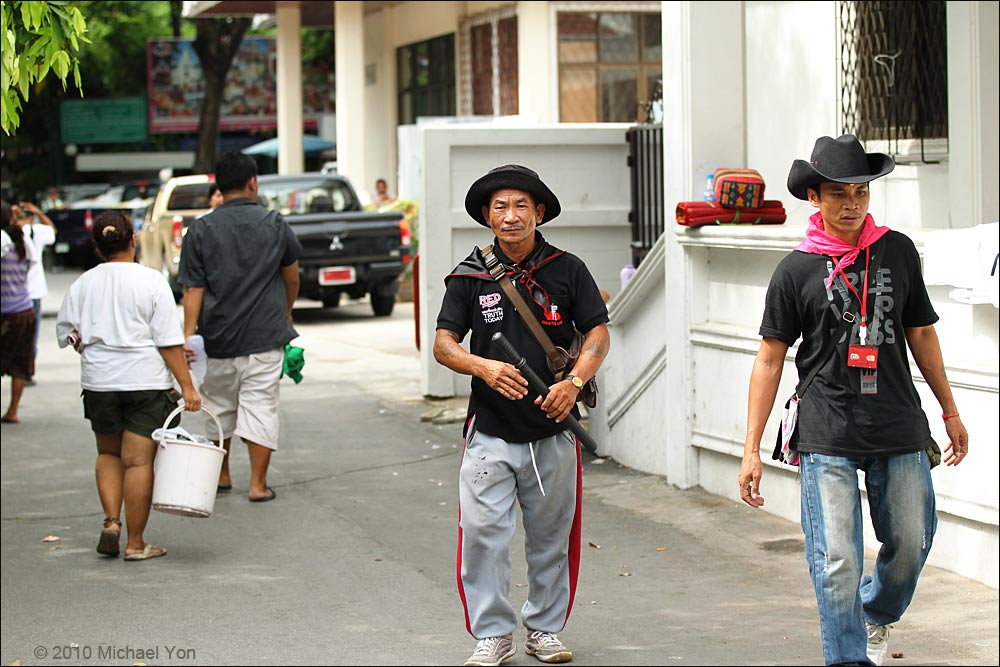
Inside Red camp at a temple where children were brought. An impartial observer likely would say they were using children as human shields.
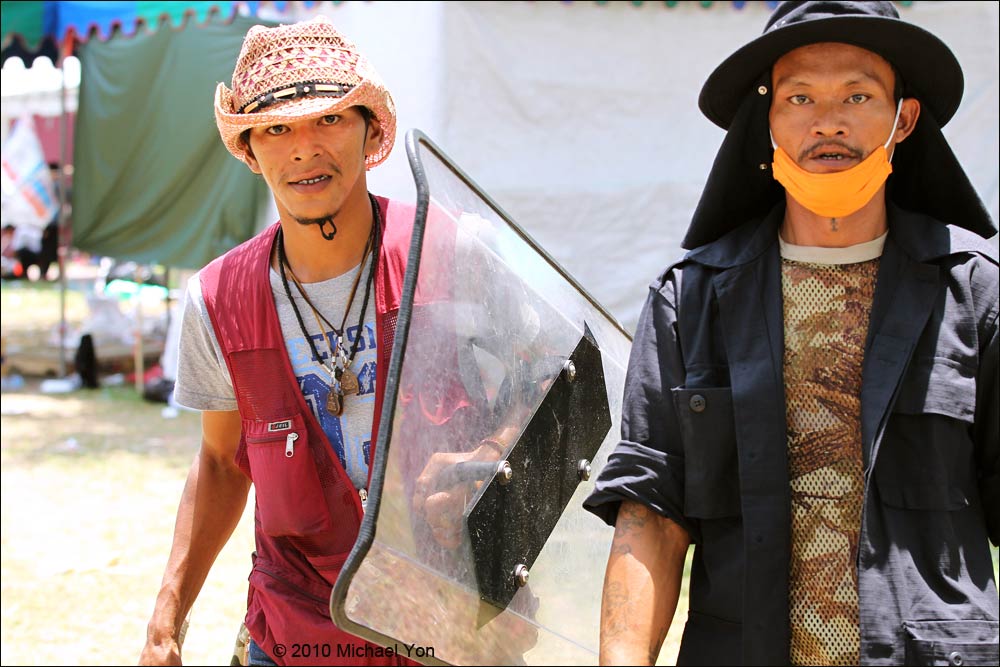
During some light fighting.
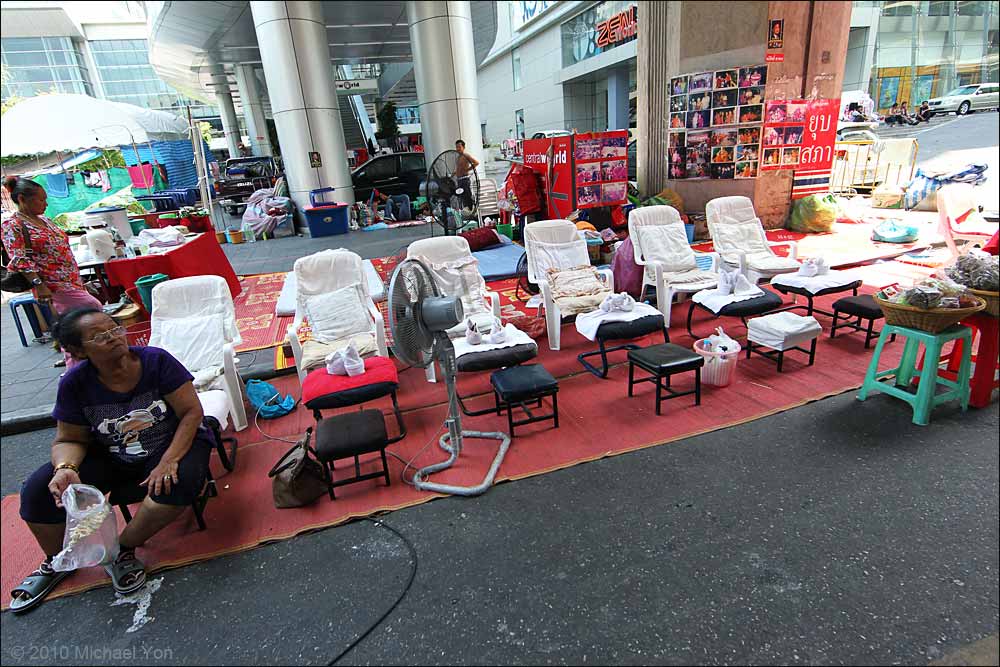
Massages were available inside the Red Shirt camp and the Army was allowing food and other supplies inside. The camp had generators and portable toilets. At one point, before I arrived, Red Shirts stormed a hospital and undermined a substantial part of their support base.
The government and Red Shirts seemed to be playing chess, and the government’s strategy seemed to avoid a push for a decisive win, while playing smart to minimize mistakes to capitalize on Red Shirt missteps. The Reds seemed more emotional. Many protestors were living on the streets for many weeks, and so seemed more apt to blunder, though others live and work in Bangkok and were known to join the protests after work. The government took pressure from some Thais who thought the Army should take a tough line and eject the protesters from the crucial business center, which amounts to Times Square in New York, but what I saw was a government who was—at great expense and also risk—wearing down the numbers of protesters. Slowly, slowly, more protesters were turning home, shrinking what might have been tens of thousands to what might now be five thousand. The numbers of protestors was a contentious, subjective subject. As with the so-called “Million Man March” in America, interests were vested. Some would have downgraded it to the “The Thousand Guys Get Together” while others would have inflated it to the “Billion Man Revolution.”
Most of the protestors were poor and nobody was keeping the secret that they were being paid to stay. Some are believed to have earned more to protest than they could earn by going home. You could see food trucks roll up, and people would line up to eat without paying, and so it was impossible, at least for me, to discern who was there for ideological reasons versus, perhaps, just a temporary job as a paid protestor or maybe something in between. Out on the streets, in the protest camp, were industrial-sized generators, similar to what our people use in Iraq and Afghanistan, running the Red Shirt fans, lights and televisions out on the streets. It was commonly reported that the people were living rough, and compared to my hotel they certainly were, but compared to the way many of our troops live in Afghanistan, the Reds were living easy with foot massages available just next to the ice-cold Red Bull, and the popcorn-cooking lady, and the beer vendor, and they were in the middle of Bangkok and the Army allowed them to freely come and go.
Interestingly, whereas tourism—amounting to about 10% of the economy—was gutted, Prime Minister Abhisit would later tell me that the overall economy continued to grow. Many articles published in international business publications lent support to PM Abhisit’s words. And so the apparent plan to bleed the Thai government was not working in the broad sense.
During mid-May, as the protests were reaching climax, the government seemed to be moving wisely. Though people losing money were angry, on a holistic national level, most people would forget the huge sums of money lost, especially given that the damage on the whole was not sinking Thailand, though many businesses—probably many thousands reliant on tourism—were bleeding bright red. Still, bleeding cash does not make for dramatic photos or journalism; bleeding cash never grabs the eyes like real blood. Whereas probably thousands of businesses were going bankrupt, they died quietly, while every human death would be magnified a hundred times and dragged through the streets for decades. There was a classic leadership dilemma. For someone who apparently had not fought a major counterinsurgency—or perhaps due to some sharp and bloody “feedback” after government mistakes fighting the separatist insurgency in the south—Prime Minister Abhisit seemed to be making decisions that even General David Petraeus might have acknowledged as masterful.
The government seemed to be playing a shrewd, long strategy and their short game mostly revolved around not allowing themselves to be baited out, preferring to bleed more cash than blood, which seemed to frustrate the remaining Red Shirts, whose leadership was trying to instigate violence, while circumventing rational thought with highly charged, emotional messages. The “man behind the curtain” clearly understands that an arsonist only needs to succeed once, but for the life of him he had not been able to provoke Thailand into civil war. He was throwing matches hoping to start a fire, while Abhisit mostly shot back with water.
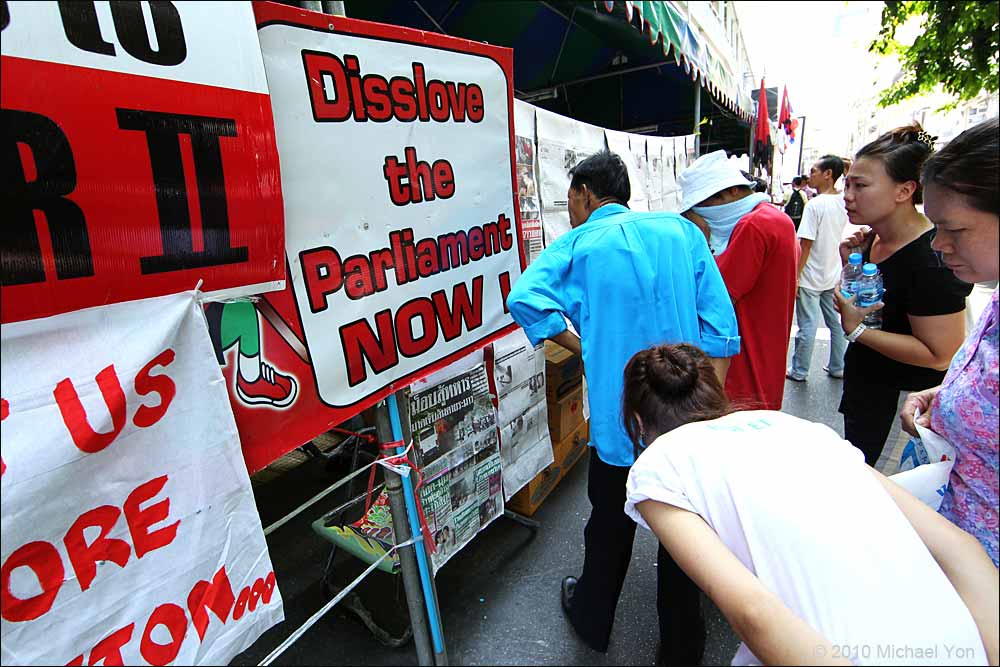
Inside the Red camp politics were thick—after all, this was politics in red ink in every sense. Much of the propaganda was in English, though few of the Reds spoke English. The Reds were doing a better job of conveying their message, and this was strangely similar to Iraq and ever increasingly in Afghanistan. The Reds seemed to be winning English-speaking media ground for several reasons. (I later met with top government press officials and suspicions were confirmed.) These reasons were similar to what we saw in particular with Iraq.
1) The Reds had more media “mass.” As we see in Afghanistan now, ANYBODY can get out the Taliban message, but only the Coalition can get out the Coalition message. To be clear—I have friends who are Red Shirts and am not comparing them to Taliban. My Red Shirt friends are peaceful and we talk and have dinner often and have travelled around Thailand together over the last couple years. This comparison is one of insurgent to government, not of Reds to Taliban. Bottom line: Communications are excellent in Thailand and techno-savvy is common. With cell phones, Internet, and venues such as Facebook and Twitter, information flies faster than bullets, and in total the Reds have more mass.
2) Despite having more mass, the Reds have less media inertia. We see this in Afghanistan where the Taliban often can run circles around us.
3) Western media tends to have bias for underdogs, and especially so in areas where we suspect the governments of being overly corrupt or forceful. In other words, we have a built-in media bias and this is likely due more to experience than some natural propensity.
In regard to the United States and United Kingdom, despite having highly trained, career media officers in our militaries who spend enormous amounts of money hiring outside consultants, our opponents and enemies often overwhelm us with mass, outrun us, and outmaneuver us with experimentation. They evolve quicker. After talking for hours over a couple different days with Thai media specialists, the parallels with the U.S./U.K. were clear. In short, the Thai government will be held to a far higher standard, while the media bias will severely punish their mistakes while tending to overlook transgressions from the underdog.
And so the government was wise to keep its inevitable mistakes to a minimum. They will be punished for every mistake and misrepresentation, while Red Shirt mistakes and flagrant propaganda will seem to evaporate into thin air.
Another “secret weapon” (if accidental) was that the Red Shirt protestors, being Thai to begin with, were very polite and friendly. This is normal Thai. However, when the Reds saw a camera, suddenly you were treated extra special. One could sense “Stockholm Syndrome” setting in among some of the journalists, but not so much among others. Though Thaksin hired public relations experts and there were talking points about dictatorship and democracy, the biggest secret weapon was Red Shirts just being friendly. It’s difficult to write bad words against sincerely friendly, peaceful people. The Men in Black are a different story.
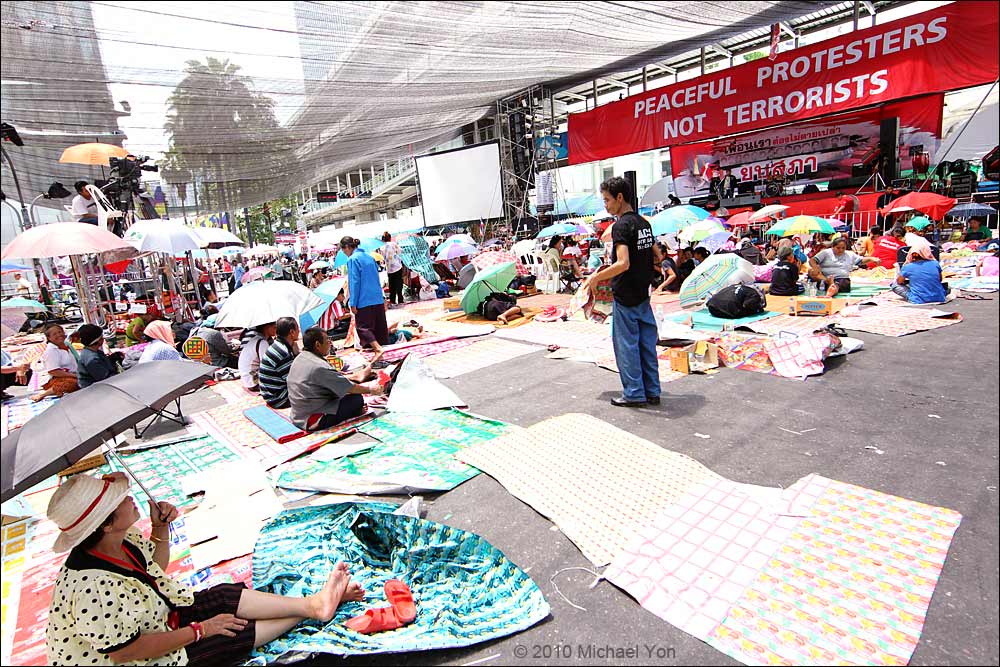
The undeniable reality is that most of the Reds are peaceful. But this is a platypus, and part of this animal is poison. (Male platypuses actually are venomous.) The violent agitators are energetic and clearly were using terrorism with their bombs, firearms, and arson. I am suspicious of people who spend effort claiming they are not terrorists.
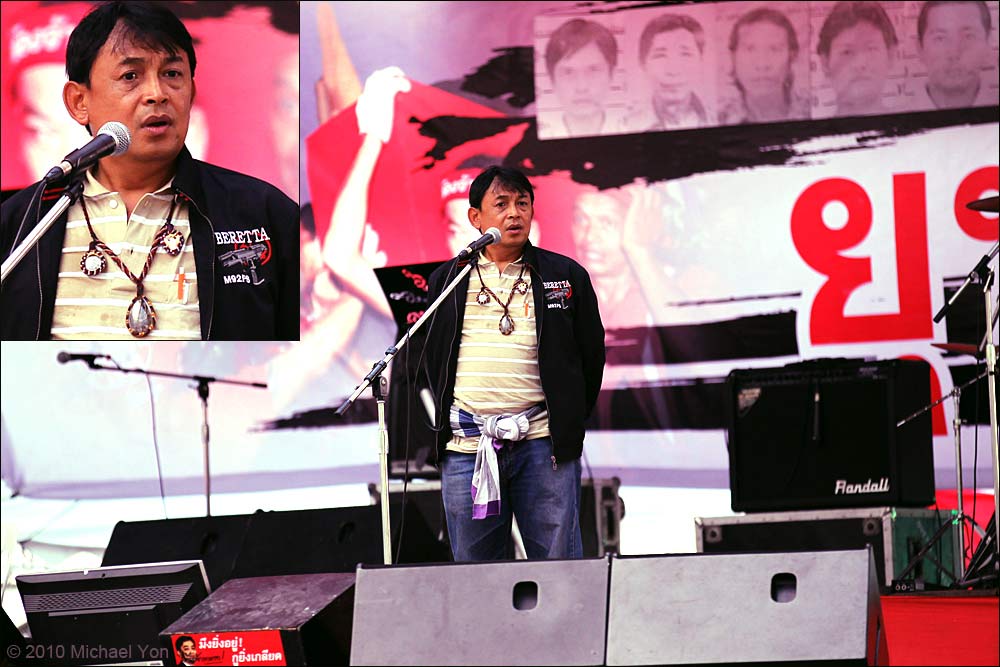
This man was giving a speech under the “PEACEFUL PROTESTORS NOT TERRORISTS” banner, while wearing a breaker advertising the Beretta 92FS pistol. U.S. forces likely would recognize this as the pistol they are issued. This man was talking in front of the cameras. What message was he trying to convey? Peaceful, or Pistol? The message was clear: GUN.


No comment yet, add your voice below!